How many control arms are on a vehicle?
When your mechanic mentions "control arms," it can sound like a major structural repair. Understanding how many of these components are on your car helps you verify the repair quote and understand the scope of the work.
Most standard economy cars and sedans have two control arms in total, located on the front axle (one lower arm per wheel). However, trucks, SUVs, and luxury vehicles with sophisticated suspension systems often have four to eight control arms, including upper and lower arms for the front and multi-link arms for the rear.
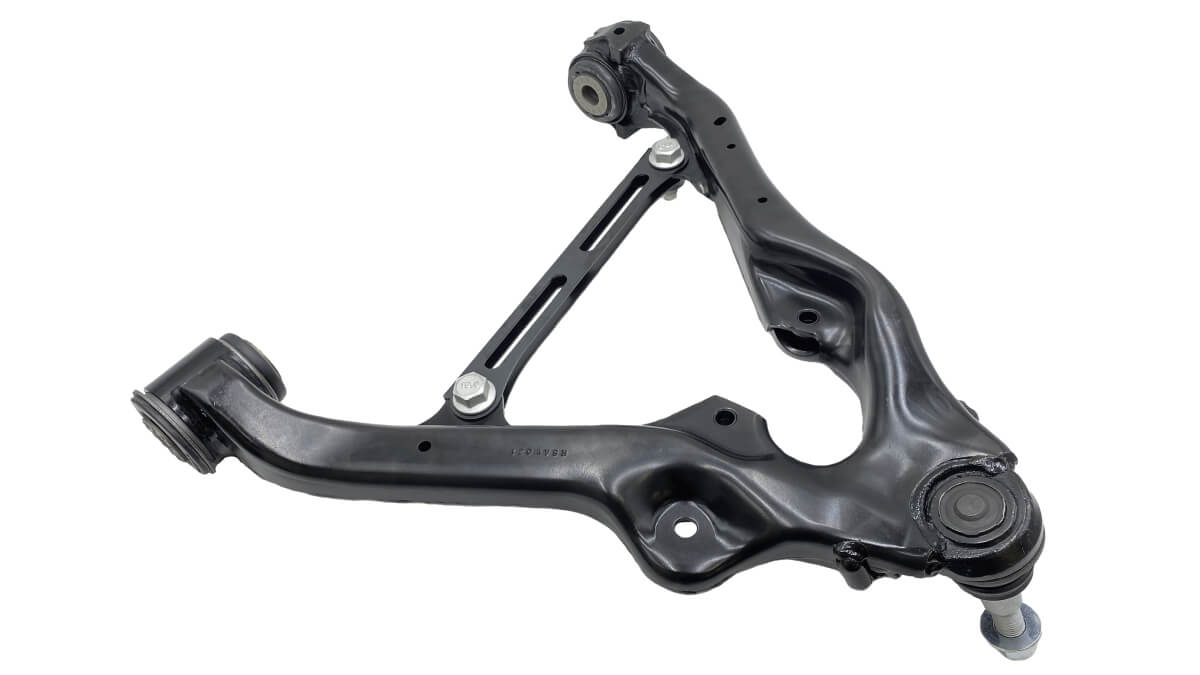
The number depends entirely on the suspension architecture. A simple MacPherson strut design uses fewer arms to save weight and cost, while a "Double Wishbone" suspension uses more arms to provide superior stability and handling.
Where is a control arm located?
If you kneel beside your front tire and look behind it, you can spot this critical component.
The control arm is located low behind the wheel, acting as the horizontal link connecting the vehicle's frame (chassis) to the wheel hub (steering knuckle). In a "Lower Control Arm" setup, it looks like an "A" or "L" shaped metal bar sitting parallel to the ground.
The Hinge of the Suspension
Think of the control arm as a heavy-duty hinge. The inner side bolts to the car frame using rubber bushings (which allow it to swing up and down). The outer side connects to the wheel using a ball joint (which allows the wheel to turn). Without this arm, your wheel would simply flop around inside the wheel well. At GSW Autoparts, we design our arms to fit these specific mounting points with OEM precision, ensuring the geometry remains perfect.
How to tell if a control arm needs replacing?
Suspension wear is often gradual, so drivers get used to the degradation. However, specific signs indicate the arm or its rubber components have failed.
You can tell a control arm needs replacing if you hear clunking or popping noises when driving over bumps, if the steering wheel feels "loose" or wanders on the highway, or if you see uneven tire wear. A visual inspection revealing torn rubber bushings or a bent metal arm confirms the need for replacement.
Noise: The most common sign is a metallic clunk. This means the rubber bushing is gone, and metal is hitting metal.
Steering: If the car pulls to the side during braking or acceleration (often called "torque steer"), the control arm bushings are too soft or torn, allowing the wheel to shift backward and forward.
Visuals: We advise checking for rust. In snowy regions, road salt can rot the steel arm from the inside out. If the metal looks flaky or thin, replace it immediately before it snaps.
Can I replace control arms myself?
With labor rates rising, many owners consider the DIY route. While possible, it is not a beginner-level job.
You can replace control arms yourself if you have intermediate mechanical skills, a floor jack, jack stands, and a torque wrench. However, the job often requires dealing with seized, rusty bolts that may need to be cut off. Furthermore, a professional wheel alignment is absolutely mandatory immediately after installation.
The concept is simple—remove three bolts, swap the arm, put bolts back. The reality is often harder. The "pinch bolt" holding the ball joint is notorious for snapping off in rust-prone areas. Additionally, tightening the bushing bolts while the car is still on the jack (wheels hanging) is a major mistake. This twists the rubber and ruins the new part instantly. You must "load" the suspension before tightening.
At GSW Autoparts, we make this easier by supplying new hardware (nuts and bolts) with our kits, so you don't have to fight to save the old, stripped fasteners.
Is replacing ball joints a big job?
Often, the metal arm is fine, but the ball joint attached to it is worn. This presents a choice: replace just the joint, or the whole arm?
Replacing a ball joint alone is a significant job because it often requires a hydraulic press to force the old joint out of the arm. For this reason, it is often faster and more cost-effective to replace the entire control arm assembly, which comes with a new ball joint and new bushings pre-installed.
Buying just a ball joint saves on parts cost but increases labor cost (or effort). You have to remove the arm, press out the old joint, and press in the new one. If you damage the arm during pressing, you have to buy a new arm anyway.
Buying a complete "loaded" control arm from GSW Autoparts resets the entire corner of the car. You get:
New Ball Joint: No pressing required.
New Bushings: Often overlooked, but critical for handling.
New Metal: No risk of hidden rust fatigue. For most customers, the complete assembly is the smarter financial and safety decision.
Conclusion
Whether your vehicle has two control arms or eight, they are the foundation of your safety on the road. Replacing them when they clunk or drift restores handling and saves your tires. We provide complete, ready-to-install control arm assemblies to make the repair faster and longer-lasting.
GSW to safeguard your needs.